
Client Gift
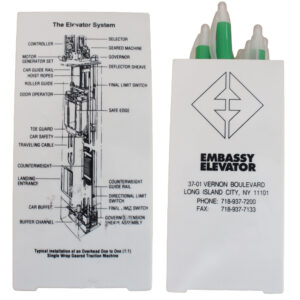
The client was looking for a gift for their clients. We turned it into a wealth of knowledge. Our client was an elevator company who provided elevator repairs. Often the elevator techs would start to explain to property managers about the needed repair. The longer the tech spoke the more the property manager's eyes glazed over. By putting a schematic on the second side of the pencil cup the property managers now had a reference guide
How does having a printed schematic on the desk actually change a client conversation?
Anyone who has ever tried to explain a technical problem over the phone, through a slide deck, or by frantically sketching on a whiteboard knows the frustration. Words alone rarely do the job when what you're really trying to communicate is visual and spatial. A printed schematic sitting on your client's desk changes the entire dynamic of that conversation.
Instead of asking your client to imagine what you're describing, you're both looking at the same thing at the same time. "This is the component causing the bottleneck." "This connection is where we're seeing the failure." "This is the upgrade we're recommending." Suddenly the conversation moves faster, misunderstandings shrink, and decisions get made with far more confidence on both sides.
There's also something about a physical object on a desk that a screen simply can't replicate. It's always there. It doesn't require opening a file or finding an email. When a question comes up -- even weeks after your last conversation -- your client reaches for what's in front of them. And what's in front of them has your name on it.
What kinds of businesses and industries benefit most from a desk schematic like this?
Any business where the product, service, or solution has moving parts -- literally or figuratively -- is a strong candidate. The industries where we've seen this work particularly well include IT infrastructure and networking, engineering and manufacturing, healthcare systems and medical devices, construction and facilities management, and financial services firms that need to map out complex processes or platforms for their clients.
The common thread isn't the industry -- it's the communication challenge. If your sales or account team regularly finds itself trying to explain something complicated to someone who isn't a technical expert, a desk schematic bridges that gap elegantly. It gives the non-technical decision-maker a way to participate in the conversation rather than feeling talked over or left behind.
It also works beautifully as a leave-behind after an initial meeting. Rather than hoping your prospect remembers what you covered, you leave them with a clear, branded visual that keeps the conversation alive and keeps your solution top of mind. Every time they look at it, they're thinking about you.
Is there another way this kind of product can help streamline client communication beyond the schematic itself?
Absolutely -- and this is one of our favorite things to talk about. A desk schematic is powerful on its own, but pair it with a custom branded notepad designed around the same layout and it becomes a genuine communication system.
Imagine your client has the schematic as a reference and a notepad where each page mirrors key sections of that schematic -- pre-labeled areas where they can jot notes, flag issues, or track questions as they come up between your conversations. When they get on a call with you, they're not piecing together scattered notes from three different places. They're working from a structured document that maps directly to the visual you both share. "I have a note here next to section four" means the same thing to both of you instantly.
That kind of intentional design -- where the physical tools you leave with a client are built to support the ongoing relationship, not just make an impression on day one -- is exactly what we love helping clients develop. It takes a promotional product and turns it into a working business tool. If that sounds like something worth exploring for your team, we'd love to schedule a consultation and think through what a complete communication toolkit could look like for your specific situation.