
Investor Holiday Gifts
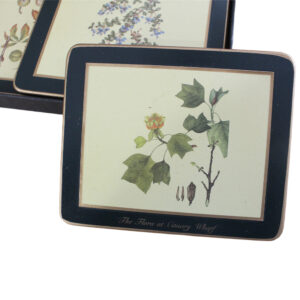
The client was looking for a way to continue using the images of a set of limited edition lithographs that they had commissioned.
We took the images and created table mats and coaster sets.
These sets were given to the investors and bankers who had taken part in many of the company's deals in the previous year. The goodwill generated by this gift helped the company get favorable terms from several of their bankers for the following six months.
What kinds of images make the best coasters and table mats for corporate gifting?
The most successful coaster and table mat programs start with a simple question: what image would someone actually want living permanently on their coffee table, their bar cart, or their dining room sideboard? That standard -- would I keep this if it had no logo on it -- is the filter that separates a genuinely beautiful corporate gift from a branded object that gets used once and quietly disappears.
With that in mind, here are the categories of imagery that consistently translate best onto coasters and table mats:
Vintage botanical prints -- detailed illustrations of flowers, plants, herbs, and foliage drawn in the tradition of 18th and 19th century natural history publishing. These have a timeless elegance that works in virtually any home décor context and photograph beautifully as a gift.
Antique and vintage maps -- city maps, regional maps, nautical charts, and exploration-era cartography. These work especially well for companies with a geographic identity or a connection to a specific city, region, or industry with a strong sense of place.
Architectural drawings and elevations -- detailed renderings of landmark buildings, historic structures, or significant architectural works. These suit corporate gifting programs particularly well when there is a connection to real estate, construction, design, or a specific city's identity.
Wildlife and nature illustration -- birds, fish, animals, and natural subjects rendered in a detailed illustrative style rather than photographically. Sporting and outdoor industries find these especially resonant, as do companies whose brand identity connects to conservation or the natural world.
Vintage travel and destination posters -- the graphic, bold color aesthetic of mid-century travel advertising translates beautifully onto coasters and mats, and carries a warmth and nostalgia that recipients respond to immediately.
Abstract and geometric art -- bold color fields, geometric patterns, and graphic abstract compositions work particularly well in sets, where the individual pieces relate to each other visually while each standing on its own.
Vintage sports and leisure imagery -- golf, sailing, equestrian, and other aspirational leisure subjects with a classic illustrative treatment suit corporate gifting programs targeting audiences where those interests resonate.
Food and beverage illustration -- wine labels, vintage spirits advertising, culinary illustration, and cocktail-related imagery are a natural fit for coasters specifically, connecting the object to its context in a way that feels both clever and appropriate.
Landmark and cityscape photography -- when rendered with the right tonal quality and printing process, iconic city views and architectural photography can produce stunning coaster sets that make an immediate connection for recipients with a tie to that place.
The common thread across all of these is that the image has a life and an identity independent of whatever branding is added to it. The art earns its place first. The brand benefits from the association.
How do I turn a lithograph or piece of existing artwork into a coaster or table mat set, and what should I know about the production process?
The good news for companies with existing artwork assets -- whether original commissions, archival prints, licensed imagery, or a collection of pieces that have been sitting underutilized in storage or rotating through a conference room -- is that the translation process is considerably more straightforward than most people expect.
The starting point is the quality of the source file. Coasters and table mats require high-resolution artwork -- typically a minimum of 300 DPI at the finished print size -- to produce results that look sharp, color-accurate, and genuinely beautiful rather than soft or pixelated. Original lithographs and fine art prints can be professionally scanned at the required resolution, and a good pre-press process will calibrate the color output to faithfully represent the tonal qualities of the original. This step is worth investing in properly, because the difference between a coaster printed from a high-quality scan and one printed from a phone photograph of the same artwork is immediately visible.
Material choice affects both the look and the longevity of the finished piece. Hardboard coasters with a smooth print surface produce vivid color and sharp detail, are highly durable, and have a weight and rigidity that feels premium in the hand. Cork-backed options add a functional layer that protects surfaces from scratching and moisture. Ceramic coasters offer a different aesthetic -- a slightly matte, almost tile-like quality that suits certain image types, particularly vintage and botanical imagery, extraordinarily well. Acrylic and glass options produce a luminous, high-gloss result that makes bold color work and graphic imagery absolutely sing.
Table mats add a dimension that coasters alone cannot -- they occupy a larger surface and therefore accommodate more compositional complexity. An image that needs room to breathe, a panoramic cityscape, a wide architectural elevation, or a richly detailed map, will often work better as a table mat than compressed onto a coaster. Coordinated sets -- four coasters and two table mats sharing the same artistic source -- create a cohesive gifting package that feels designed rather than assembled.
Minimum quantities, lead times, and finishing options vary by material and supplier. As with any quality-sensitive product, requesting a pre-production sample before approving a full run is always time well spent.
Can promotional products solve real business problems beyond marketing -- and what does that actually look like in practice?
This is one of the most important and most underappreciated ideas in the entire promotional products industry. The instinct is to think of branded merchandise as a marketing tool -- something that puts a logo in front of people and generates awareness. And it does that. But the most creative and most valuable applications of promotional products go considerably further, solving operational, logistical, safety, training, and communication challenges that conventional business solutions address less elegantly and often at far greater cost.
Consider a few examples of what this looks like in practice:
Equipment and asset identification. A manufacturing facility, a hospital, a hotel, or any organization managing large numbers of physical assets faces a constant challenge of identification, organization, and accountability. Custom labeled products -- tags, bands, sleeves, pouches, cases -- can be color-coded, numbered, and branded to create an immediate visual identification system that reduces errors, speeds up inventory, and improves accountability across an entire operation.
Safety communication. Safety procedures, emergency protocols, hazard warnings, and compliance information need to live somewhere accessible and permanent. Custom printed products -- laminated cards, badge reels with printed inserts, desk references, hard hat stickers, floor mats with safety messaging -- put critical information exactly where it needs to be, in a format that withstands the environment it operates in.
Staff training and reference tools. New employee onboarding, product knowledge training, and procedural reference are perennial challenges in industries with high turnover or complex product lines. A custom printed reference card, a branded desk tool, a laminated quick-reference guide, or a product identification chart produced as a promotional piece gives staff what they need in a form they will actually use and keep.
Wayfinding and space organization. Large facilities -- hospitals, convention centers, corporate campuses, hotels, warehouses -- face ongoing challenges of directing people efficiently through complex spaces. Custom signage, floor graphics, directional tools, and branded environmental elements solve these challenges while simultaneously reinforcing the organization's visual identity.
Customer education and self-service. A product that helps customers use your service more effectively, navigate a complex process, or understand a technical subject reduces the burden on your support team while improving the customer experience. A beautifully produced reference card, a custom measuring tool, a branded guide, or a product selector tool can do this work quietly and persistently in a way that a website page or a phone call cannot.
Menu and product presentation. Hospitality businesses, retailers, and service providers constantly face the challenge of communicating offerings clearly and attractively. Custom printed coasters, table mats, menu holders, and product display pieces solve a presentation problem and a marketing problem simultaneously -- they make the environment more beautiful while making the offering more legible.
The thread connecting all of these examples is the same: a physical object, chosen and designed thoughtfully, can solve a problem that a meeting, a policy document, or a digital solution addresses less effectively. The best promotional products professionals think this way by default -- not "what can we put your logo on" but "what problem does your organization need to solve, and what physical tool could solve it." That is a fundamentally different and considerably more valuable conversation. Reach out and let's have it.