
Community Service Award
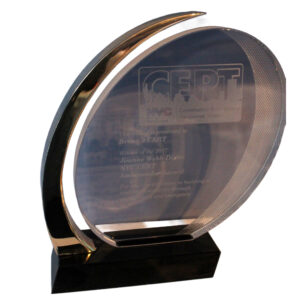
These annual awards are given to individuals and community organizations that create good disaster planning programs.
Because so many of these awards are presented to organizations on of the requirements is that it be an award that will look nice in a public space at the recipient comany/organization
It is presented at a ceremony recognizing the organizations work for the community
What materials are available for custom awards, and why should I think beyond crystal?
Crystal is beautiful and has its place -- but it's also what everyone expects, which means it blends into the background of every awards shelf and trophy case it lands on. The most memorable awards are the ones that feel like they were chosen with intention, and that often means looking at materials that bring something unexpected to the moment.
Wood is one of the most underappreciated award materials available. It's warm, tactile, and feels genuinely substantial in a way that resonates across industries -- from environmental organizations to financial firms to tech companies. Bamboo offers a similar warmth with a sustainability story built right in. Both take laser engraving beautifully, producing crisp, elegant personalization that feels artisanal rather than mass produced.
Metal awards -- aluminum, brass, iron, and steel -- project a sense of permanence and weight that suits lifetime achievement recognition, military and first responder honors, and industries where toughness and durability are part of the brand identity. They can be cast, cut, etched, or finished in ways that range from sleek and modern to richly traditional.
Acrylic deserves more credit than it typically gets. Modern acrylic awards can be produced in virtually any shape, color, and finish -- frosted, mirrored, colored, layered -- and they photograph exceptionally well, which matters more than ever when award recipients are sharing moments on social media. Stone and marble bring gravitas and a sense of legacy. Glass offers clarity and elegance without the associations that come with standard crystal.
The right material tells a story about what the award represents and who is receiving it. That story is worth getting right -- and we love helping clients find it.
How do I match the award material to the occasion and the recipient?
The best awards feel inevitable -- like the moment you see them, you can't imagine the recognition happening any other way. Getting there requires thinking about three things: the nature of the achievement being recognized, the culture of the organization giving the award, and the person or group receiving it.
A sustainability award presented in bamboo or reclaimed wood carries its message in the material itself before a word is read. A sales achievement award in heavy brushed metal feels earned in a way that a lightweight acrylic piece simply doesn't. A creative excellence award in a bold shaped acrylic with full color printing feels appropriate in a way that a traditional plaque might not. The material should reinforce the meaning, not work against it.
Organizational culture matters too. A startup with a casual, design-forward identity might find that a sleek modern acrylic or a minimalist wood piece lands better than something that reads as traditional or corporate. A law firm or financial institution honoring a long tenure might want the gravitas of metal or stone. A nonprofit honoring community volunteers might find that warmth and approachability -- wood, bamboo, a softer finish -- resonates more than grandeur.
And the recipient themselves is always worth considering. Someone who will display an award in a home office has different needs than someone who will put it in a corporate lobby or carry it home on an airplane. Size, weight, and durability all factor into whether an award gets proudly displayed or quietly stored.
These are exactly the kinds of questions we work through with clients before making any recommendations. Every situation is a little different, and the right conversation at the start saves a lot of second-guessing later.
Can awards be produced in combinations of materials, and what does that open up creatively?
Absolutely -- and some of the most striking awards we produce are the ones that bring two or more materials together deliberately. A wood base with a metal medallion. An acrylic centerpiece mounted on a stone platform. A metal frame surrounding an engraved glass panel. Each combination creates a visual and tactile contrast that makes the award feel considered and complex rather than off-the-shelf.
Mixed material awards also allow different elements to do different jobs. A weighted base provides stability and presence. A lighter upper element can be shaped more freely and decorated more elaborately. An engraved metal plate can carry personalization cleanly while the surrounding material provides visual drama. The result is an award that holds the eye from across a room and holds meaning up close.
Full color printing, dimensional logos, custom shapes, and embedded elements like coins, medals, or branded inserts can all be incorporated depending on the materials involved and the story you want to tell. The creative range is genuinely wide.
What brings all of this together is a clear sense of what the award needs to communicate and to whom. That's always the starting point for us -- and it's a conversation we find endlessly interesting. If you have an awards program coming up and want to explore what's possible, reach out for a consultation. We'll bring the ideas and you bring the occasion.