
Deal Commemorative
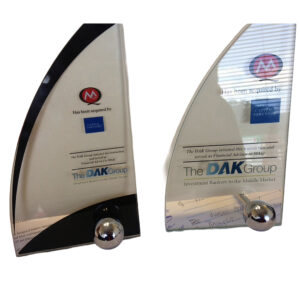
A middle market lending firm wanted to gift all those involved in the deal with a "tombstone" instead of the traditional block of lucite with a piece of paper embedded inside, we chose this unique shaped piece of crystal.
What exactly is a deal toy, tombstone, or deal commemorative -- and why do they go by so many names?
All three terms refer to the same category of custom recognition piece, and the variety of names actually reflects how much the format has evolved over the decades. The term tombstone is the oldest, dating back to when these pieces were almost exclusively produced as rectangular slabs of lucite or acrylic -- simple, upright, and yes, a little tombstone-shaped. The financial industry embraced them early as a way to commemorate significant transactions, and the name stuck even as the designs became far more sophisticated.
Deal toy emerged as a more informal, industry-insider term -- a nod to the fact that these pieces mark the closing of a significant deal and often end up displayed as prized possessions on desks and shelves throughout investment banking, private equity, mergers and acquisitions, and capital markets. There's an element of pride in the term that the more formal alternatives don't quite capture.
Deal commemorative is the broadest and most accurate description -- it simply means a custom-crafted physical object created to mark a significant financial, legal, or business transaction. It acknowledges that these pieces have grown well beyond their lucite origins into genuinely creative three-dimensional works that can be made from virtually any material in virtually any form.
Whatever you call them, the purpose is the same: to create a lasting, tangible marker of a moment that mattered. Something that sits on a desk or a shelf and tells a story every time someone picks it up or asks about it.
Who commissions deal commemoratives and what kinds of transactions do they typically mark?
The short answer is: anyone involved in a transaction significant enough to deserve recognition -- and the range is wider than most people assume. The format originated in investment banking and remains deeply embedded in that world, where tombstones marking IPOs, mergers, acquisitions, bond issuances, and private equity transactions are practically a professional rite of passage. Walk through the offices of any major financial institution and you'll find shelves lined with them, each one a chapter in the firm's story.
But the deal commemorative has expanded well beyond its Wall Street roots. Law firms commission them to mark landmark cases and major closings. Real estate developers create them for groundbreakings, building completions, and significant sales. Private equity and venture capital firms produce them for fund launches and portfolio exits. Corporate development teams use them to mark strategic partnerships, licensing agreements, and joint ventures. Even technology companies have adopted the format to commemorate major product launches, company milestones, and funding rounds.
The common thread is significance. These are moments that took years of work, involved teams of people, and represented something genuinely worth marking. A deal commemorative says that the moment deserved more than a handshake and a press release -- it deserved something permanent. Something that will still be sitting on that desk in twenty years, still prompting the story.
How creative can a deal commemorative actually get -- are there limits to what's possible?
The honest answer is: virtually none. This is the category where imagination genuinely is the primary constraint, and we mean that in the most literal sense. The days of the format being limited to a rectangle of lucite with text embedded inside are long behind us. Today's deal commemoratives are custom-fabricated three-dimensional objects that can take almost any form, incorporate almost any material, and tell almost any story.
The transaction itself is usually the richest source of inspiration. A shipping company closing a major fleet acquisition might have a commemorative crafted in the form of a vessel. A renewable energy deal might be marked with a piece incorporating actual turbine or solar panel materials. A real estate closing might feature a miniature architectural rendering of the property. A tech acquisition might incorporate circuit board elements or custom-machined components that reference the company's product. We have seen commemoratives shaped like chemical compounds, geographic maps, sports equipment, musical instruments, and abstract sculptures -- each one a direct expression of the deal it represents.
Materials are equally open-ended. Lucite and acrylic remain popular for their clarity and the way they can suspend objects, text, and color within a solid form. Metal, wood, glass, stone, resin, leather, and mixed media combinations are all in play. Custom packaging, presentation cases, and accompanying printed pieces can extend the commemorative into a complete experience rather than a single object.
There is no template here, no standard size, no expected shape. Every deal commemorative we produce starts with a conversation about the transaction, the people involved, and what the piece needs to say. From there, the creative possibilities are genuinely limitless -- and that is exactly what makes this one of our favorite categories to work on. Reach out and let's start that conversation.