
Press Release Gift
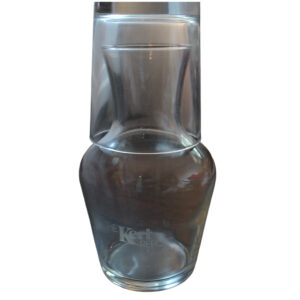
Reporters get ideas and information pitched to them every day. In order to stand out from the crowd, the PR agency responsible for this brand asked us to come up with something useful that would stay on the reciients desk reminding them of the brand and product. This water Carafe Set was sent to healthcare reporters together with the PR kit for Keri as part of a larger program being run by their PR agency. The water and moisture tie in were a natural. It was an item that would stay on the recipients desk giving long term brand recognition.
Can a glass carafe or crystal piece be used to get a press release noticed, and how does sending a physical gift change the equation?
In a world where journalists receive hundreds of digital press releases every week, almost all of which look identical in an inbox, the ones that actually get opened and acted upon are the ones that arrive differently. Sending a beautifully packaged crystal carafe to a journalist or editor alongside your press release is not a gimmick -- it is a fundamentally different communication strategy, and it works for reasons that are worth understanding.
The physical object arrives on a desk. It gets unwrapped. It is held, examined, and admired before a single word of the accompanying release is read. That sequence matters enormously. By the time the journalist turns to your press release, they have already had a tactile, sensory experience with something genuinely beautiful -- and that experience colors everything they read afterward. Your announcement doesn't arrive as one more email competing with hundreds of others. It arrives as an event.
Crystal is particularly well suited to this strategy for a specific reason: it is immediately and unmistakably impressive. A quality crystal carafe is not something a journalist can glance at and set aside. It catches the light, it has weight and presence, and it communicates without any words that whoever sent it takes quality seriously. That impression transfers directly to the story you are asking them to tell about your company, your milestone, or your announcement.
The piece also provides a natural visual for the story itself. Crystal photographs with a luminosity that cheaper materials cannot replicate, and a well-lit image of the carafe -- ideally with your custom engraving visible -- gives the editorial team a hero image they actually want to use. In print, online, and on social media, a beautiful photograph is not a secondary consideration. It is often the difference between a story that gets prominent placement and one that gets buried.
The logistics of this approach require some advance planning -- selecting the right piece, coordinating custom engraving or branding, packaging it beautifully for shipping, and timing delivery so the physical piece arrives in conjunction with the release rather than days before or after. The press release itself should reference the piece directly, giving the journalist context for what they've received and why it connects to the announcement.
When all of those elements come together, a physical gift paired with a press release becomes one of the most effective media relations tools available -- especially for milestone announcements, major partnerships, award programs, and recognition moments that deserve more than a paragraph in a crowded inbox. We'd love to help you plan both the piece and the program around it. Reach out and let's talk through what that could look like for your next announcement.
What makes a glass carafe an unexpected but effective choice as a branded corporate gift or award?
There is a category of gift that lives permanently on a dining table, a sideboard, or a bar cart -- visible every time guests arrive, present at every dinner party, part of every celebratory pour. A glass carafe occupies that category in a way that almost nothing else in the corporate gifting world does. It isn't tucked in a drawer or stored in a closet. It isn't charged and forgotten on a shelf. It sits out, it gets used, and it gets noticed -- which means your brand or your recognition moment is woven into some of the warmest and most social occasions in someone's life.
The carafe also carries an inherent elegance that few promotional or recognition products can claim without trying too hard. Glass is timeless. It works in every aesthetic context from a modern minimalist kitchen to a traditionally furnished dining room. It doesn't go out of style, it doesn't date itself, and it doesn't compete with the recipient's existing décor -- it completes it. For corporate gifting programs where the goal is to communicate genuine appreciation rather than obligatory recognition, that kind of graceful restraint is exactly the right tone.
There is also something worth noting about what a carafe says symbolically. It is a vessel designed for sharing -- for pouring for others, for gathering around a table, for the kind of moments that mark relationships rather than transactions. As a gift from one company to another, or from an organization to someone it wants to honor, that symbolism is quietly powerful. The right gift says something about the giver, and a carafe says generosity, warmth, and good taste without a word of explanation.
How do I choose between standard glass and crystal, and what should I look for in a quality piece?
This is one of the most common questions we get in this category, and it deserves a thoughtful answer because the difference between a piece that impresses and one that underwhelms often comes down to exactly this decision.
The practical distinction between glass and crystal has evolved considerably. Traditionally, crystal referred to glass containing lead oxide, which gave it exceptional clarity, weight, and the characteristic ring when tapped. Modern crystal is typically lead-free, using barium or zinc compounds to achieve the same optical qualities without the health concerns associated with lead. When someone says a piece is crystal today, they generally mean it has that superior clarity, refractive quality, and weight -- regardless of the specific chemistry involved.
What that means in practice: crystal catches and bends light in a way that standard glass simply doesn't. Hold a quality crystal carafe up to a window and it throws small rainbows across the room. Set it on a table and it glows from within. That optical quality is immediately perceptible to anyone who sees or handles it, and it is what makes crystal feel like a premium gift rather than a nice one.
Beyond the material itself, a few construction details signal quality in a carafe. Wall thickness matters -- a piece that feels substantial in the hand without being heavy communicates craftsmanship. The base should be flat and stable, sitting cleanly on a surface without any wobble. The opening should be smooth and finished, with no rough edges that would interfere with pouring or cleaning. Clarity should be consistent throughout the piece with no bubbles, striations, or cloudiness in the glass.
For branded or engraved pieces, crystal takes engraving beautifully -- the contrast between the engraved surface and the surrounding glass is crisp and elegant in a way that is far more impressive than a printed or applied logo. The engraving becomes part of the piece rather than something added to it, which is exactly the right feeling for a recognition or gifting item that is meant to last.