
Mural Contest
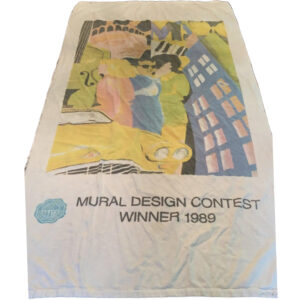
The client ran this mural contest every year for NYC high school students. Each year the winning mural would be painted on the side of their building. In 1989, it was decided that instead of choosing a random gift for the company's annual golf outing, they requested something on which we could print the winning mural. The obvious choice was a beach towel. It provided a large imprint area. We were able to print it in full color (today that would be an easy dye sublimation job, but in 1989...) and beach towels are a fantastic golf outing gift.
Why does a beach towel work so well as a branded corporate gift or promotional item, and what occasions call for one?
A beach towel occupies a rare category in the branded merchandise world -- it is large, it is used in public, and it goes everywhere summer goes. To the beach, the pool, the lake house, the resort, the backyard. Every time it gets spread out on the sand or draped over a chair, your brand is displayed at full size in a social, relaxed environment where people are paying attention to their surroundings in a way they simply aren't during a workday. The visibility-to-cost ratio on a quality beach towel is genuinely hard to beat.
The occasions that suit a branded beach towel are equally varied. Corporate summer events and client appreciation outings are an obvious fit -- a towel handed out at a company beach day or pool party gets used immediately and then travels home to be used again all summer long. Conference and trade show giveaways work particularly well when the event is in a warm-weather destination, where a towel feels immediately relevant rather than aspirational. Resort and hospitality brands, financial services firms doing summer client gifting, sports teams and outdoor brands, and companies running summer promotions all find that a well-chosen beach towel performs consistently as a high-perceived-value item that recipients genuinely want.
The key word is quality. A thin, scratchy towel with a faded print communicates something about your brand that no amount of clever design can overcome. A plush, vibrant, well-constructed towel communicates something entirely different -- that you chose this thoughtfully and you chose the best version of it. That distinction is felt the moment someone picks it up.
How do I decode beach towel weight, and why does it matter so much when choosing the right product?
Towel weight is one of those specifications that looks like a technical detail but actually tells you almost everything you need to know about how a towel will feel and perform. Understanding it before you order saves a lot of disappointment when the product arrives.
Towel weight is measured in GSM -- grams per square meter -- which is a standard textile industry measurement that describes the density of the fabric. The higher the GSM, the heavier, thicker, and more absorbent the towel. The lower the GSM, the lighter and thinner the fabric. Here is a practical breakdown of what the numbers mean in real terms:
300 to 400 GSM is the entry-level range for beach towels. These are lightweight and dry quickly, which has its advantages for travel and beach use, but they feel noticeably thin in the hand and don't communicate premium quality. They work for very high-volume, budget-conscious programs where quantity is the priority.
400 to 500 GSM is the mid-range sweet spot for most branded beach towel programs. These towels have enough weight to feel substantial without being heavy to carry, they absorb well, and they hold their color through repeated washing. This is where the value-to-quality balance tends to be strongest for corporate programs.
500 to 600 GSM is where towels start to feel genuinely luxurious -- thick, plush, and absorbent in a way that recipients notice immediately. These are the towels that communicate that the person who chose them was not cutting corners. For high-end client gifting, executive recognition programs, and luxury brand activations, this range is worth the investment.
600 GSM and above is the premium tier -- the kind of towel found in high-end hotel spas and beach clubs. They are heavy, exceptionally soft, and feel like a genuine indulgence. As a branded corporate gift this tier makes a powerful statement, though the weight does make them less practical for events where recipients need to carry them home easily.
One additional note worth understanding: GSM applies to the base fabric, but construction details like loop density, pile height, and the quality of the cotton used all affect how a towel actually feels independent of its weight measurement. Two towels at the same GSM from different manufacturers can feel noticeably different in the hand, which is why seeing and feeling samples before committing to a large order is always time well spent.
What print options are available for beach towels, and how do I make sure my design looks as good on the towel as it does on screen?
Beach towels offer more print real estate than almost any other promotional product, and using that canvas well is what separates a towel people want to be seen with from one they leave in the car. Understanding the print options available helps you match the right production method to your design and your goals.
Reactive dyeing is the gold standard for beach towel printing. In this process, the dye chemically bonds with the cotton fibers rather than sitting on top of the surface, which produces colors that are vivid, deeply saturated, and exceptionally resistant to fading through sun exposure and repeated washing. If your design is bold, colorful, and all-over -- meaning it covers a significant portion or all of the towel surface -- reactive dyeing is almost certainly the right choice. The results are stunning and the longevity is genuinely impressive.
Screen printing works well for simpler designs with a limited number of solid colors and defined edges. It's a reliable, cost-effective option for logos and graphic designs that don't require photographic detail or gradients. The limitation is that screen printing sits on top of the fabric rather than bonding with it, which means it can crack or fade over time with heavy use -- particularly relevant for a product that will see sun, salt water, and frequent washing.
Sublimation printing allows for photographic detail, gradients, and complex full-color designs across the entire surface of the towel. It produces exceptional color accuracy and is particularly popular for fashion-forward, pattern-heavy designs. The consideration with sublimation is that it works best on polyester or polyester-blend fabrics, which have different feel characteristics than pure cotton -- worth knowing if the plush, absorbent quality of cotton is important to your program.
Getting the design right for any of these methods starts with understanding how fabric texture affects visual output. A design that looks crisp and precise on a screen will read slightly differently on a textured woven surface -- colors can appear slightly different, very fine lines may lose some definition, and small text can become difficult to read. Working with a designer who understands textile printing, or requesting a pre-production sample before committing to your full order, is the most reliable way to make sure what arrives matches what you envisioned.
We work through these decisions with clients every day and we are happy to help you find the right combination of weight, construction, and print method for your specific program. Reach out for a consultation and let's build something worth taking to the beach.